
The nutrient sweet spot for optimal potato yields
More fertiliser isn't the answer. This trial shows how reading the ratios between nutrients, not their totals, lifted marketable yield and tuber quality without raising inputs.
As featured inFarmer's Weekly
One of the reasons potato farmers aren't getting the marketable yields they should is nutrient deficiencies and imbalances, not a shortage of fertiliser. Many programmes still run on generic norms developed for cultivars no one plants anymore.
Newer varieties carry far higher yield potential, so growers push more fertiliser at the crop, rarely asking how the applied elements react with each other, or whether an oversupply of one is quietly suppressing another. DRIS analyses the ratios between nutrients to find exactly that: the limiting factor, and what's causing it.
Too much nitrogen was suppressing calcium
Reviewing years of tissue and sap data turned up a recurring culprit: too much nitrogen, especially early in the season. High N drives vegetative growth at the expense of roots and reproduction, and it suppresses calcium, the element most responsible for internal tuber quality.
Simply applying more calcium didn't work. Only when the nitrate load was brought down could calcium move into the plant, and into the tubers, where it lifts quality and shelf life.
Nutrient balance index
Each nutrient is plotted against its DRIS norm. The goal isn't “more”. It's the centre band, where elements work in synergy rather than suppressing one another.
- N+32
- Ca-18
- N+2
- Ca-2
- Very low / very high
- Low / high
- Optimum
Illustrative of the diagnostic pattern; positions are schematic.
“As soon as the nitrates were addressed, calcium levels in the plant could be corrected, which translated to higher levels in the tubers, and a better-quality end result.”
Charles le Roux, DRIS
Fix the soil, then feed the balance
The DRIS Crop Monitoring Protocol started before planting with soil analysis and correction. Finely micronised lime and gypsum were applied, not only to lift calcium, but to flocculate compacted soil, restore oxygen flow and rebuild structure. Aeration is the foundation of nutrient availability; without it, even the best fertiliser falls short.
From there, the planting mix was tailored to the soil and to each growth stage: emergence, vegetative, tuber initiation, bulking and maturity. Crop monitoring every two weeks, with follow-up samples, let the programme adjust nutrition in real time as the season unfolded.

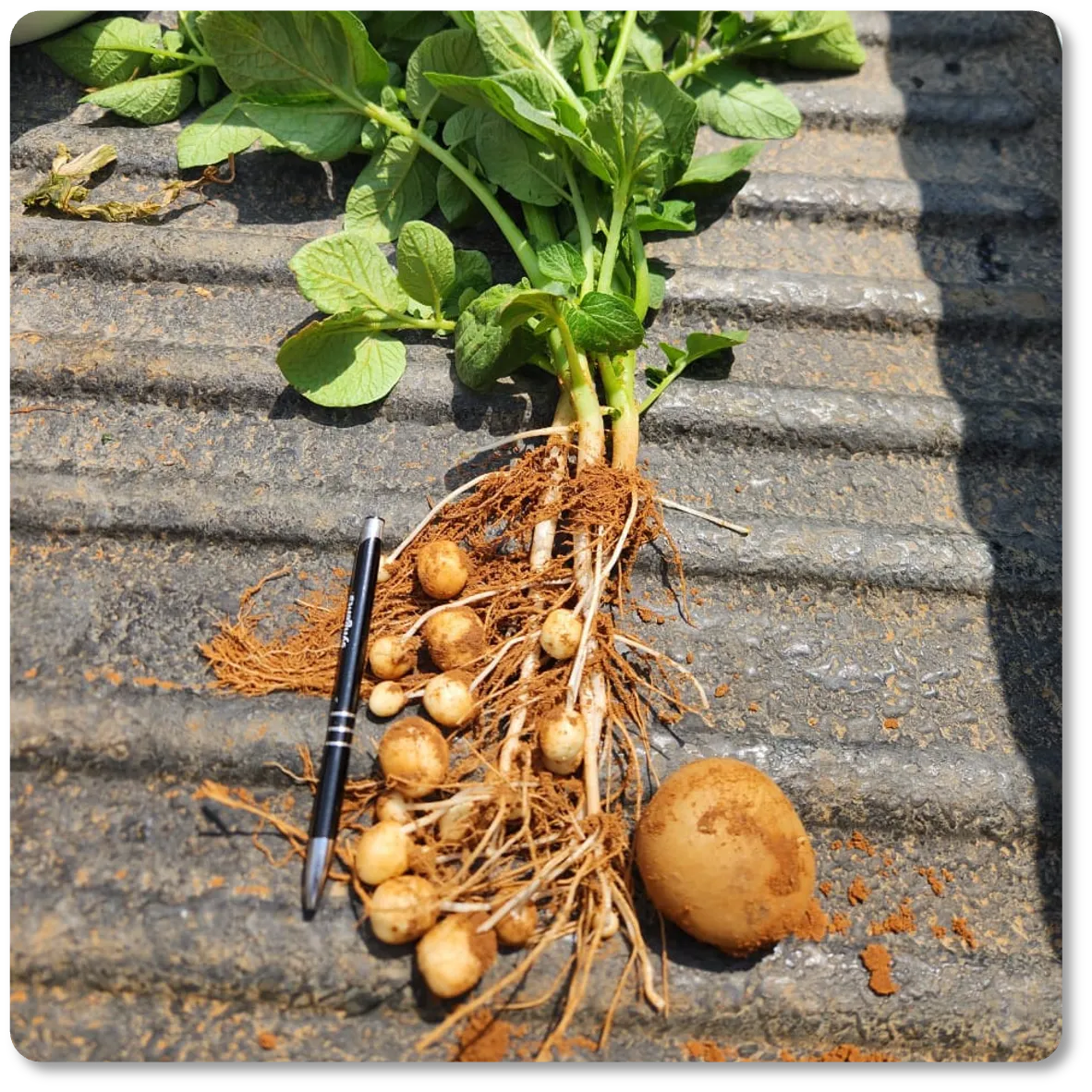
Controlled early vegetative growth let the plants invest in roots first, building a deep, healthy system that fed efficient uptake and stood up to stress. Precise foliar applications brought earlier tuber initiation and short, strong stolons with no tuber weaning, setting up uniform size and quality.
Through bulking, consistent plant energy and the aeration from micronised calcium supported even tuber growth, and helped the crop recover quickly from an early frost. Shifting from an N-based to a calcium-driven strategy also reduced pest pressure and produced a more resilient crop.
Notably, total yield showed no significant increase. But the share that reached market did. Fewer oversized and undersized outliers meant more of the crop paid its way, all without lifting input costs.
Source
This case study draws on DRIS field data and an interview with Charles le Roux, as told to Lindi Botha for Farmer's Weekly, “Nutrient sweet spot for optimal potato yields”, 6 June 2025. Photographs in the original feature by Lindi Botha.
Read the original feature in Farmer's Weekly →Find your crop's limiting nutrient.
Send us one existing lab report and we'll show you what's holding your yield back, free.
Create a free account →