
About DRIS

The Original Beaufils DRIS Method.

Dr E.R. Beaufils developed DRIS in the 1970s to address the limitations of the standard norms and thresholds used for plant nutrition.

The origin

Fifty years of balance-based nutrition.

DRIS, the Diagnosis and Recommendation Integrated System, was developed in the 1970s as a statistical method that reads soil and leaf samples to determine the true nutrient status of a crop. Not what's sufficient or deficient in isolation, but how every element sits in balance with every other. Over five decades, DRIS has grown from a research method into a fully integrated diagnostic and recommendation system.

  1. 1970s

    The origin: Dr E.R. Beaufils

    DRIS was developed by Dr E.R. Beaufils at the University of Natal, South Africa. His work established the principle that plant nutrition is best diagnosed through the ratios between nutrients, not their absolute levels, a foundation the system still rests on today.

  2. 1990s – early 2000s

    The partnership: Ronald Schroder

    Ronald Schroder, senior agronomist, joined Dr Beaufils as research associate. Over more than ten years, they worked in partnership to build the DRIS theory into a working interpretation and recommendation system. Dr Beaufils passed away in the early 2000s, before the system could be released to the public. Ronald continued the work.

  3. 2000s – today

    The stewardship: Ronald Schroder

    For the past twenty years, Ronald has led the development of DRIS: refining the methodology, expanding it across crops, and building the reference standards that make ratio-based diagnostics reliable in the field. Every recommendation the system produces today rests on that continuous work.

  4. 2023 – today

    The next chapter: Charles le Roux

    Charles partnered with Ronald in 2023 to bring DRIS to the next generation of farmers. To scale the system beyond a manual, per-sample basis, DRIS needed a modern digital platform, one that puts fifty years of methodology into the hands of farmers and agronomists across Africa and beyond, without diluting the science that sits behind it.

A diagnosis is only as good as the correction that follows it. I've spent twenty years pairing DRIS interpretations with the specific products and solutions that resolve them, so the recommendation isn't just accurate, it's actionable.
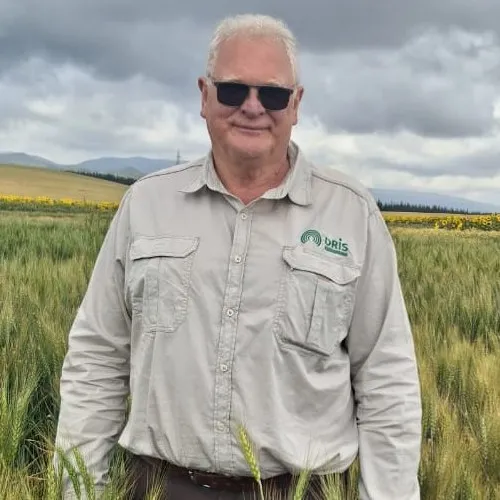
Ronald Schroder, Technical Director · DRISRonald SchroderTechnical Director · DRIS
The science is sound. My job is to make sure it reaches every farmer in a form they can use, every day.
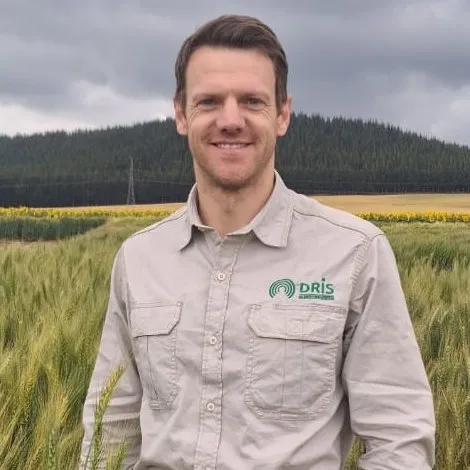
Charles le Roux, Managing Director · DRISCharles le RouxManaging Director · DRIS
Only one of its kind

DRIS is the only holistic system that reads soil, tissue and sap analysis together.

Why · What · How

Clarity, where there used to be complexity.

Why

Finding the root cause

Fertiliser costs keep climbing. Yields don't.

The problem isn't a shortage of nutrients. It's imbalance: nutrients undermining each other, starved roots, soil function no standard test captures.

That's why DRIS exists: to find what's limiting your crop, and why.

What

The engine behind the diagnosis

DRIS isn't a one-off test. It's the agronomy engine reading every soil, leaf, and sap sample against every other element in it, built on 50+ years of Beaufils-lineage research, refined for the way farmers work today.

How

From static data to practical decisions

1Reads soil, leaf, and sap data as one ratio-based diagnosis.
2Weighs each nutrient against the others, not against a fixed norm.
3Flags what's limiting growth, and what's suppressing the nutrients around it.
4Sharpens with every cycle. More data, tighter diagnosis.
Positioning

DRIS is the agronomy engine.

Your lab takes the sample. Your agronomist makes the call. DRIS does the diagnostic work in between, reading the balance between every nutrient, weighed against 50 years of reference methodology, and handing back one actionable instruction: fix this first.

We don't replace your lab. We don't replace your agronomist. We give them a diagnosis they can defend.

Input
Your lab
Takes the soil, leaf and sap sample.
Engine
DRIS
Reads the balance. Ranks what to fix first.
Output
Your agronomist
Makes the call, with a diagnosis they can defend.
Why we do this

Stewardship, not just science.

Farming is a divine calling, a great responsibility, and a great blessing. To work the land is to be actively involved in the ongoing work of creation itself: to watch what has been entrusted to us grow, feed, and renew.

DRIS is our contribution to that work: a tool that helps farmers work more in tune with what God intended the soil, the plants, and the seasons to be. Because when the balance is right, nature does what it was made to do: flourish, and feed the nation with healthy, nutrient-dense crops.

Creation is resilient, even after decades of soil desertification. And one of the answers we focus on is balance. Balance is not a metaphor. It is measurable. When DRIS reads the ratios between nutrients, it is reading the design of a system that already knows how to work, and correcting what has drifted out of alignment. When balance is restored in the soil, oxygen returns, biology revives, and nutrient availability follows: a whole ecosystem, brought back into function.

That is why we take the science of balance seriously. Because getting it right honours the farmer, the creation, and the Creator.

God has called us to steward the land and feed the nation. It is not an impossible task. We simply need to see how creation was designed to function: in harmony, in balance. A fine balancing act.
Charles le RouxManaging Director · DRIS
Proof · In the press

Documented in the field, not just the lab.

For more than a decade, the DRIS method and its agronomists have been covered independently in Farmer's Weekly, South Africa's national farming publication, in case studies across sugarcane, pineapples, vegetables and potatoes.

Sugarcane · Pongola, KZN

92120t/ha
yield lift across ten seasons (2002 to 2012)

A 2003 DRIS liming trial on Ernst Höll's farm flagged low calcium and high magnesium and ranked the fix. Sixteen years on, the same cane still yields at first-cut levels, double the usual ratoon life for the region.

R6,000/ha of soil correction returned roughly R50,000/ha in the 2012 crop.

Pineapples · Hluhluwe, KZN

R65kR30k/ha
input costs roughly halved

Ronald Schroder interpreted Anton Louw's soil audits, working the calcium-to-phosphate ratio and soil biology into one programme. The result: his best pineapple yield since 2003, after five months without rain.

8,000 boxes/ha harvested through an eight-year drought.

Potatoes · Farmer's Weekly SA

Around 1 000 more bags to market.
marketable yield & tuber quality up

Featured in Farmer's Weekly. Reading the ratios between nutrients, not raising inputs, found the potato nutrient sweet spot: the nitrate load came down, calcium balanced, and roughly 1 000 extra 10 kg bags of marketable potatoes came off each hectare, more uniform and better-quality.

Total yield held flat. The marketable share is what rose, with no extra input cost.

Stop guessing. Start growing.

Upload your existing lab reports and we'll show you your crop's balance and the limiting nutrients, free.